Unfolded· 7 min read·10 July 2026
The Sky the Desert Kept Clean
Guided astronomy at the Paracas coastal reserve — an evening session with an astronomer, portable telescope, and a Southern Hemisphere sky catalogue that includes the Southern Cross, the Magellanic Clouds, and the dark-cloud constellations of the Andean astronomical tradition. Not astrology. Not a spectacle. An introduction to the sky as a scientific object.
By Kada Travel Editorial
The Milky Way at Paracas casts a shadow. Not a poetic figure of speech — a physical shadow, cast on the ground by the density of galactic light, on any clear winter night between May and October when the sky reaches Bortle 2 and the Pacific air is dry enough to transmit what is actually overhead. Most people who consider themselves interested in astronomy have never stood in a Milky Way shadow, because most of them look at the sky from cities, or suburbs, or locations where residual light reduces the galactic structure to a haze rather than a lit canopy. What the Paracas Reserve provides — the combination of Pacific desert aridity, two hundred and fifty kilometres of dark coastline north to Lima, and stable marine air that does not shimmer — is not what stargazing tours usually mean when they say 'dark sky.' It is closer to what the sky was before electricity: a structure that shapes the night the way a full moon does, that fills from horizon to horizon, that makes its own light.
Most guided stargazing experiences are organised around the telescope: the eyepiece view of Saturn's rings, the laser pointer tracing the familiar constellations, the tour of objects from the Northern Hemisphere catalogue. The session Kada arranges begins before the telescope comes out. It begins at dusk, with the astronomer standing beside you in the coastal dark while your eyes adjust over fifteen minutes — the biological process that converts daylight vision to night vision and that most stargazing experiences skip entirely because the group has a schedule. What reveals itself in that window, from this latitude, is not the Northern Hemisphere sky translated south. It is a different sky with different navigational references, a different dominant structure in the galactic centre, and a different astronomical tradition that could only have been developed here: the dark cloud constellations the Inca read in the Milky Way's nebulae rather than in the bright stars themselves.
The Southern Hemisphere Sky as a Different Map
In the Northern Hemisphere, the primary navigational reference is Polaris — the star that sits approximately at the North Celestial Pole and does not appear to move while all other stars rotate around it. From the Southern Hemisphere, there is no equivalent bright star at the South Celestial Pole; the navigation reference is a constellation: the Southern Cross, whose long axis, extended five times, points toward the approximate location of the invisible south pole.
The Southern Cross (Cruz del Sur in the sky visible from Paracas) is not a navigational myth. It is a functional tool that the Polynesian navigators used across the Pacific, that the Inca used in combination with the horizon calendar of rising and setting positions, and that the European navigators who rounded Cape Horn required for their southern latitude calculations. From Paracas at fourteen degrees south latitude, it is visible for significant portions of every night. Learning to find it, orient by it, and understand its relationship to the rest of the southern sky is the foundation of the evening's session — not because it is the most interesting object overhead, but because it is the anchor that makes everything else findable.
The Milky Way From This Latitude
The galactic centre of the Milky Way — the densest and brightest section of our galaxy, where the central bulge of several hundred billion stars is visible as a concentrated haze — is not well placed for observation from the Northern Hemisphere. From the Southern Hemisphere, between approximately May and September, the galactic centre transits near the zenith: directly overhead, at the highest possible altitude, where the least atmospheric interference reduces the distortion and brightening of the sky background that degrade the view at lower elevations.
From Paracas in June, the galactic centre is overhead around midnight. The core of the galaxy — the bright nucleus of the Milky Way band, with the dark dust lanes that define its structure — is visible to the naked eye with the clarity that only a Bortle 2 sky and a dark-adapted eye together provide. The structure of the galaxy is legible in the same way that clouds have structure: not uniform brightness but a complex of brighter and darker areas, lanes and concentrations, arms curving away from the central bright region.
The dust lanes in the Milky Way — the dark nebulae that appear as irregular dark patches against the brighter stellar background — are the objects the Inca read as sky animals. Where the Western astronomical tradition saw figures in the bright stars, the Andean tradition saw figures in the dark spaces between them. The cosmic llama, the fox, the toad, the partridge (yutu), the serpent — these yacana (dark cloud constellations) are visible from the Southern Hemisphere sky where the galactic centre is prominent, and invisible or faint from the Northern Hemisphere where it is not. The Paracas astronomer describes both traditions at the same object: the molecular cloud that a European observer reads as an absence of stars and that an Inca observer read as the llama drinking from the Milky Way's celestial river.
This parallel reading is not offered as a cultural curiosity or a decorative footnote to the astronomy. It is the methodological claim of the session: that the dark cloud constellations represent a parallel and equally rigorous sky-reading practice, developed from the same Southern Hemisphere sky over centuries of careful observation, and that understanding them changes what you see when you look at the galactic centre. Not the same object with an interesting footnote attached — the same sky, legible in two different scientific languages, simultaneously.
The Magellanic Clouds
The Large and Small Magellanic Clouds — satellite galaxies of the Milky Way, orbiting us at approximately 160,000 and 200,000 light years — are visible from the Paracas latitude as two irregular bright patches in the southern sky, roughly the brightness of the densest sections of the Milky Way but detached from its main band. Ferdinand Magellan's crew documented them in 1519; they are named for him in the Western tradition, though they were known to Southern Hemisphere cultures for thousands of years before European navigation reached these latitudes.
In the session at Paracas, the Magellanic Clouds represent a specific kind of observational landmark: the most distant objects visible to the human eye without optical aid under good conditions. A casual unaided glance at a Bortle 5 or 6 sky (the quality of most suburban locations) would miss them entirely. From Paracas at Bortle 2, they are unambiguous. The astronomer's portable telescope resolves the Large Magellanic Cloud's internal star field — the individual stars and star clusters visible as grains within the haze — converting what the eye reads as a misty patch into a recognisable galaxy with internal structure. This transition — from patch to galaxy — is one of the session's most reliably affecting moments.
What This Is Not
The distinction the programme maintains is important enough to state directly. This session is not astrology — the study of the supposed influence of astronomical objects on human affairs. Kada does not offer zodiac readings, birth chart interpretations, or any product in that category. The session is observational astronomy and the history of how different cultures have read the same sky; it is science and the humanities, not fortune-telling.
It is also not a star photography workshop, a meditation experience, or a romantic package that happens to take place outdoors at night. The astronomy session is what it is described as: an introduction to the Southern Hemisphere sky with a qualified astronomer, using optical instruments, with explicit acknowledgement of what is known, what is inferred, and what remains uncertain. Guests who want a scientifically rigorous framework for what they are seeing, with the Andean tradition presented as an equally serious sky-reading practice rather than as mythology, will find the programme meets that standard.
What Kada Arranges
The astronomer Kada works with has spent years studying the intersection of Western observational astronomy and the Andean astronomical tradition — not as a cultural curiosity appended to a conventional telescope tour, but as the central subject of his work. He has taught at the university level and trained at a professional observatory, and his particular competence is the ability to hold both frameworks simultaneously in the field: the Southern Cross as a navigational instrument that Polynesian and European navigators depended on, and the Southern Cross as one element in the Inca sky-reading system where the dark cloud constellations carry the primary cosmological weight. He does not work from a script. He conducts a conversation calibrated to the questions the guests bring, and the session runs differently for every group — which is what a practitioner rather than a tour guide produces in the field.
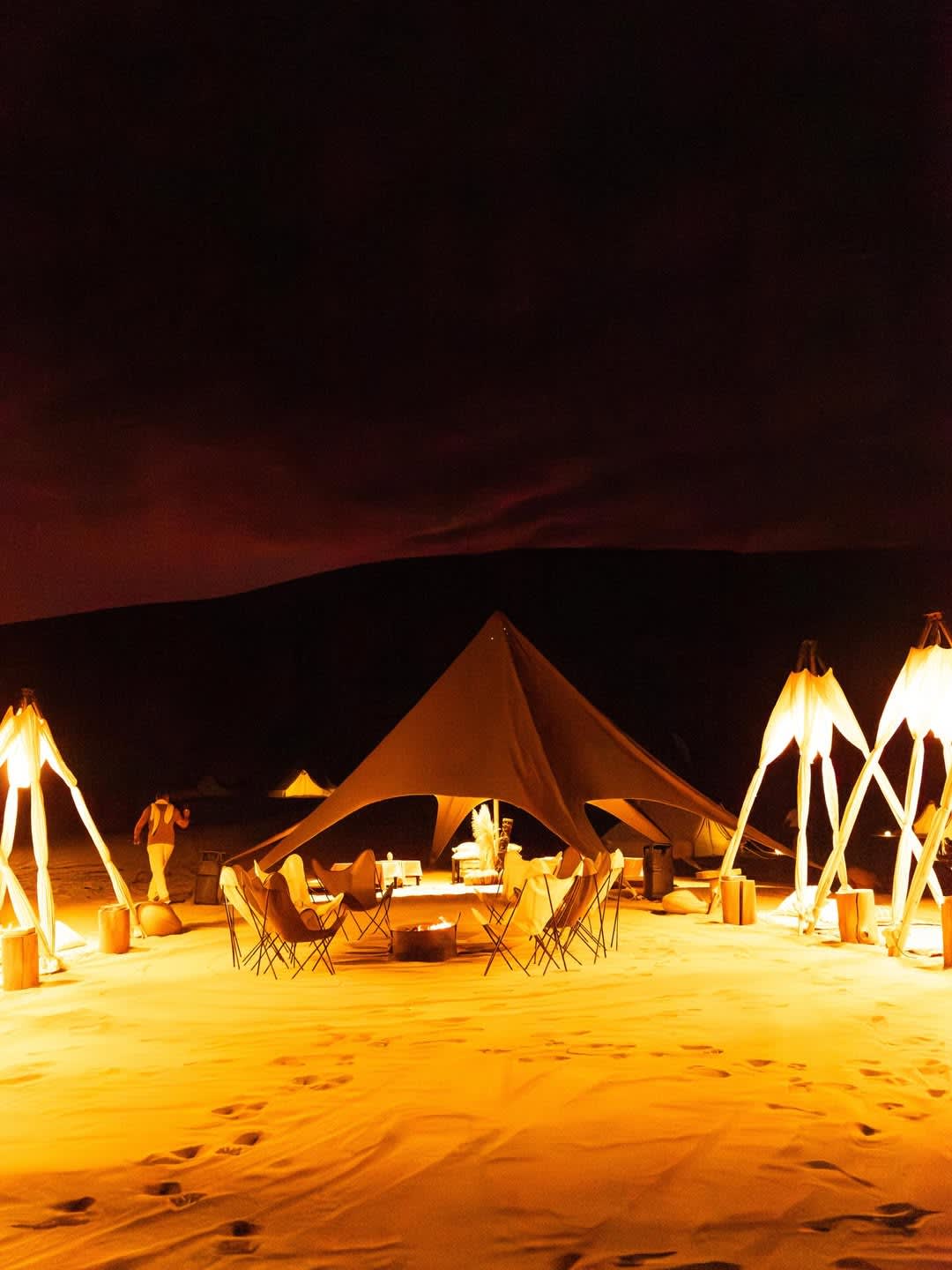
Evening transfer to a dark-sky location within the Paracas Reserve — the same terrain as the day's marine biology programme, now in darkness — for a session running two to three hours with the astronomer. The programme begins at dusk, which allows the gradual transition from twilight to full dark to be used as a demonstration of dark adaptation and the sky's progressive revelation: the brightest objects first, the faintest last.
The astronomer's equipment includes a portable refractor or reflector telescope appropriate for the session's objectives — wide-field for the Milky Way and Magellanic Clouds, higher magnification for the Moon (when present), star clusters, and the Orion Nebula. A star chart for the evening's sky and a red-light torch are provided for each guest. The session is not a lecture; it is a guided conversation, directed by the astronomer and shaped by the questions the guests bring.
A simple dinner — or a post-session meal on return to the hotel — is arranged as part of the evening. The session runs late enough that returning to the hotel for dinner is practical rather than disruptive to the sky session.
Expert Perspective
"When I first came to Paracas after years of looking at the sky from Lima, the difference was physical. I had read about dark skies in descriptions of observatory sites, and I assumed those descriptions were technical — about what instruments could detect, not what the human eye would see. I was wrong. At Paracas, on a winter night, the Milky Way casts a shadow. Not a perceptible dimming of the ambient light — an actual shadow. I have stood in that shadow and understood something about what a pre-electric sky looked like to everyone who ever lived under it: not the sky we call 'starry' as a poetic contrast to city light, but a sky so dense with light that it shapes the night the way a full moon does. The Paracas session is my attempt to give guests thirty minutes of that understanding and the vocabulary to hold it afterward."
— Katherine Cjuiro, Founder, KADA Travel
A Practical Note
Best season: the optimal window for the Paracas astronomy session is May through October, when the galactic centre is well-placed in the evening sky and the austral winter's low humidity maximises atmospheric transparency. Sessions are available year-round; the summer sky (November-April) is scientifically rich but the galactic centre position is less optimal in the early evening hours.
Moon phase: the full Moon illuminates the sky strongly enough to significantly reduce the number of faint objects visible. Kada schedules the astronomy session to avoid the full Moon and the days immediately surrounding it; the new Moon and the first-quarter window provide the darkest sky. Guests who have specific travel dates should communicate them in advance so Kada can advise on the sky conditions.
Dark adaptation: the quality of the unaided-eye experience depends on spending fifteen to twenty minutes in complete darkness before the session begins. Phone screens and bright lights reset this process. The programme begins with a dark-adaptation period; guests should plan to avoid screens for that interval.
Children: the session is appropriate for children from approximately eight years old, with the astronomer calibrating the explanation to the group's age range. The telescope eyepiece height can be adjusted; the session's duration and content are adaptable.
Written by Kada Travel Editorial
Frequently Asked
Under good conditions: the full Milky Way band including the galactic centre, the Southern Cross at navigational clarity, the Large and Small Magellanic Clouds, several bright planets (depending on the current planetary position), and several thousand individual stars. The limiting naked-eye magnitude at Bortle 2 reaches approximately 6.5 — significantly fainter than what is visible from most urban or suburban locations.
The portable telescope used in the session resolves: the internal star field of the Magellanic Clouds, star clusters including the Pleiades and the Jewel Box near the Southern Cross, the Orion Nebula (a gas cloud visible with the naked eye but resolved as a complex multi-region structure in the telescope), the Omega Centauri globular cluster, and the Moon's surface in significant detail when the Moon is in the sky.
The Paracas coast has a cloud pattern influenced by the Humboldt Current: low coastal stratus forms in the mornings and typically clears by midday in most seasons. Evening cloud cover is less common than morning fog; the astronomer assesses conditions before the evening transfer and advises on whether the session is viable. In the rare event that cloud cover prevents observation, the session is rescheduled.
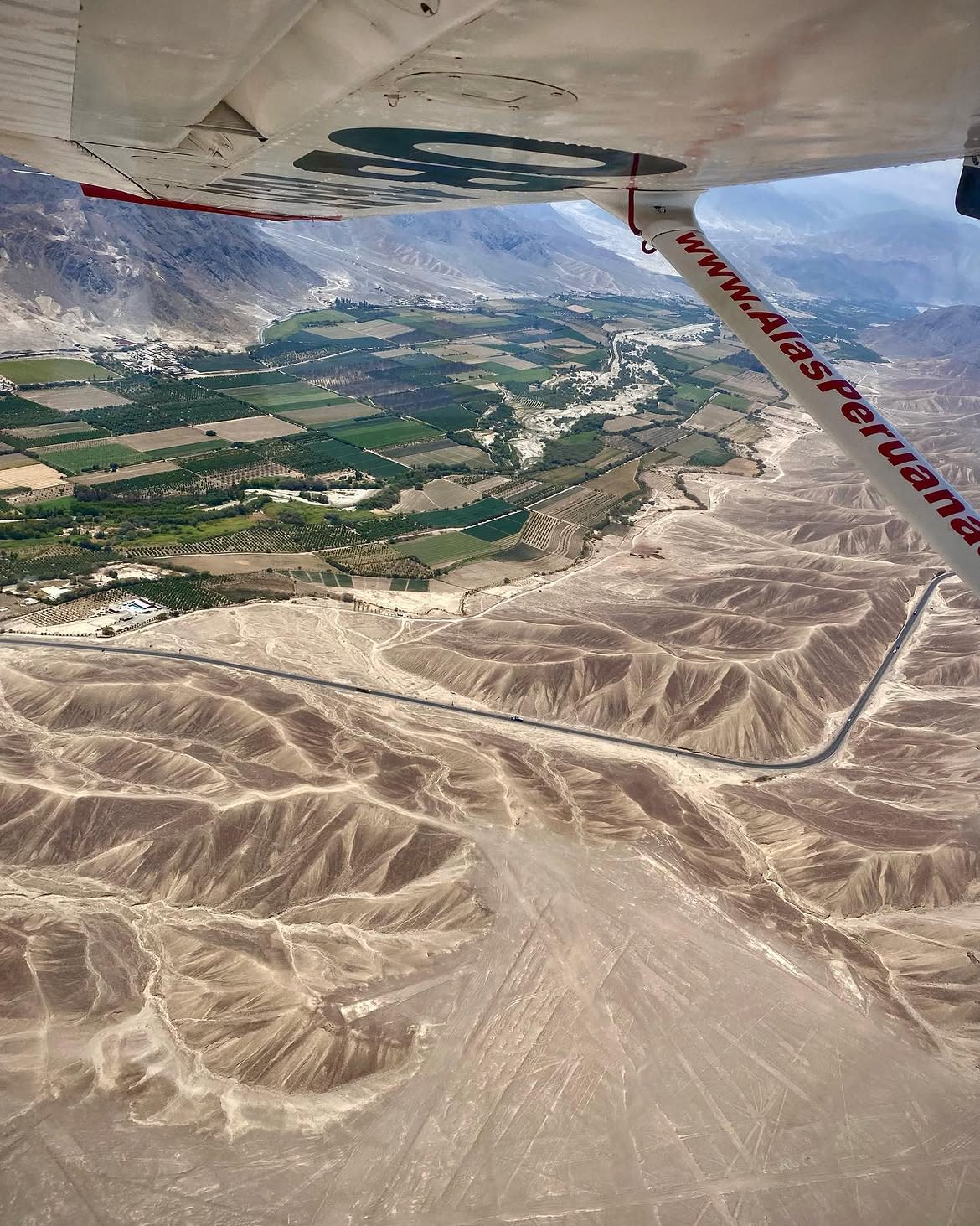
The relationship between the Nasca Lines and Andean astronomical practice is part of the active scholarly debate about the Lines' purpose. The astronomer addresses this at the session: the evidence that some Lines align with solstice and equinox positions, the competing interpretations, and the way the Inca dark-cloud constellation tradition — which is demonstrably connected to agricultural and ritual timing — provides a framework for understanding how pre-Columbian cultures used the sky as both a map and a calendar.
Design Your Journey
Design your bespoke Peru journey
We talk. We listen. Then we design an itinerary that belongs only to you.
Start Planning