Unfolded· 8 min read·15 July 2026
What the Andenes Remember
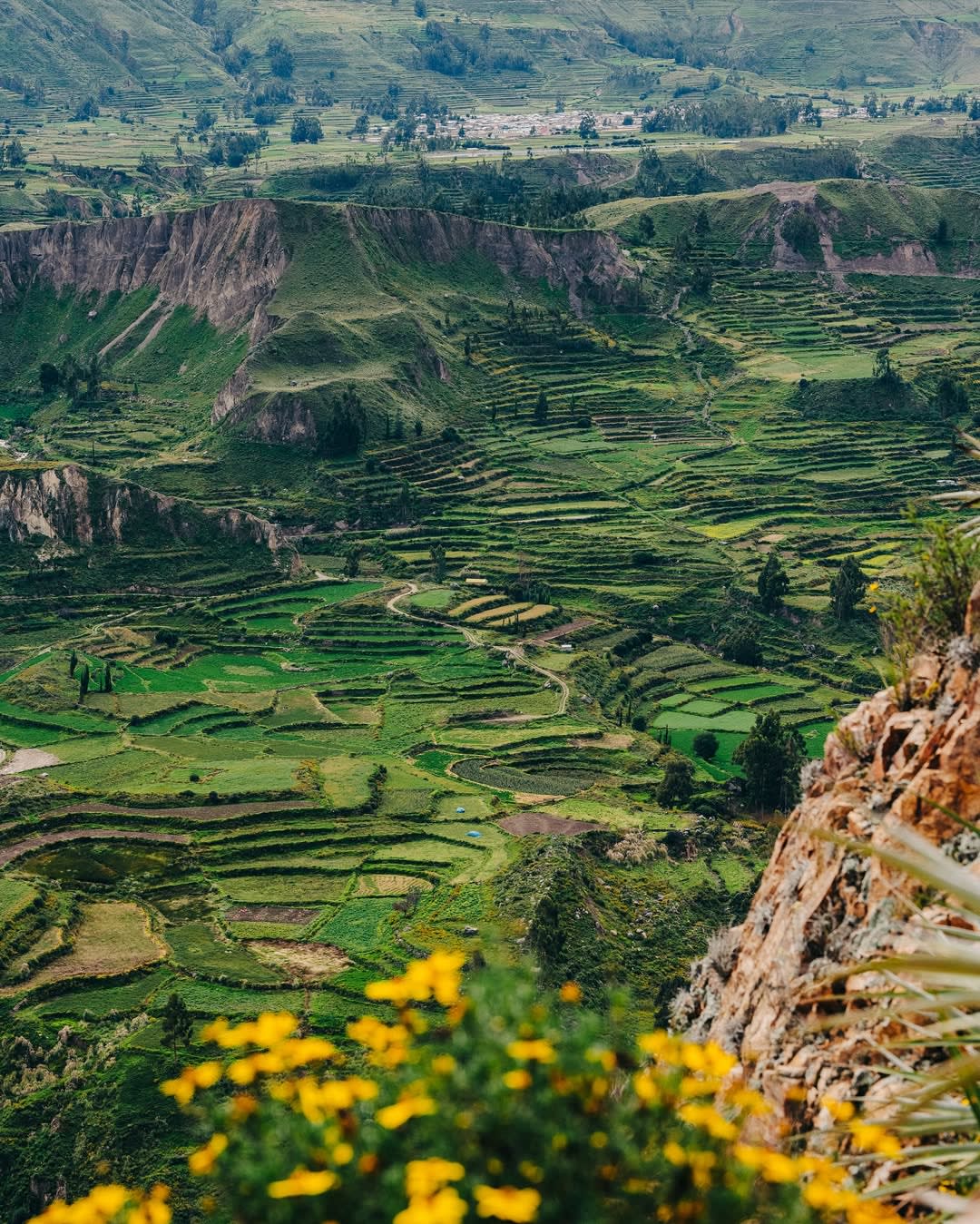
A walk through the pre-Inca agricultural terraces of the Colca Canyon with an agronomist who studies traditional Andean cultivation — 6,000 hectares of hand-built terracing, still productive after eight centuries, with the crops and the hydraulic logic explained from inside the fields.
By Kada Travel Editorial
The andenes are not ruins. This is the first thing the agronomist says when the walk begins, and it is the correction most necessary for visitors who have seen photographs of the terraces from the canyon rim and assumed, from the distance and the scale, that they are looking at something historical — preserved, photographed, explained — rather than something active.
At least half of the andenes in the Colca Canyon are currently under cultivation. Farmers from the valley communities descend to their terraces before dawn and climb back after dark. The crops are the same crops — in many cases literally the same varieties — that were planted here when the terraces were first built, between 800 and 1,000 CE, by the Collagua and Cabana peoples who inhabited the valley before the Inca arrived. The irrigation channels that water the terraces draw from the same glacier-fed sources that the original builders identified. The agronomic logic that determined where to build each terrace, which crop to plant on which level, and how to rotate the fields across seasons has been maintained, in practice if not always in written record, through approximately thirty generations of continuous cultivation.
The Engineering
A single anden — the individual terrace unit within the larger system — is a compression of several distinct technologies into a retaining structure that, when functioning correctly, is invisible as engineering. It appears to be a flat field on a steep slope. What it actually is: a stone retaining wall (pirca) built without mortar from locally sourced rock, calibrated to the angle and load of the slope above it; a drainage layer behind the wall, composed of coarse gravel and broken stone, that prevents water from saturating the fill and destabilising the wall; a nutrient-rich topsoil fill above the drainage layer, accumulated from organic material and maintained by crop rotation; and a micro-irrigation system that delivers water to the field surface at a rate calibrated to the crop's water requirements without eroding the soil or waterlogging the drainage layer.
The construction of a new anden, in the traditional method, requires: selecting the appropriate location on the slope (aspect, angle, drainage above and below, relationship to existing channels); quarrying or sourcing the pirca stone; building the retaining wall to the correct height and batter (the slight backward lean that distributes the load correctly); laying the drainage material; and importing or accumulating the topsoil. A single terrace of moderate size — approximately 40 by 10 metres — might require a year of part-time communal labour. The 6,000 hectares of Colca andenes represent a construction effort that took centuries and involved the entire canyon population.
The Inca, when they incorporated the Colca valley into the empire in approximately the 1450s, recognised the andenes as a significant resource and expanded the system rather than replacing it. The Inca contribution — identifiable in archaeological analysis by construction style and material sourcing — extended the terrace network into areas previously uncultivated and introduced modifications to the acequia (irrigation channel) network that increased the efficiency of water distribution across the expanded system. The Colca andenes are therefore a palimpsest: Collagua and Cabana construction beneath, Inca expansion and modification above, colonial period alteration in places, and continuous farmer maintenance throughout.
Identifying those layers is not possible from the canyon rim or from a photograph. The agronomist can point to the specific course of stonework where one civilisation's work ends and another's begins — a distinction that requires knowing what to look for, and years of looking.
The Crops
The microclimate of the Colca Canyon is not a single climate. The canyon runs approximately 100 kilometres from east to west, dropping from the high puna at its eastern headwaters (above 4,000 metres) to the lower western canyon below Cabanaconde (around 2,000 metres). Within this range, the andenes create a further gradation: the aspect of a terrace (whether it faces north or south, whether it is in morning sun or afternoon shadow), its altitude on the canyon wall, and its position relative to the irrigation channels all determine its microclimate. A skilled farmer works a system of terraces that span several of these microclimates simultaneously, planting different crops on different levels to exploit the variation.
The principal crops of the Colca andenes are:
Papa nativa: The Colca valley preserves more than a hundred native potato varieties that are not commercially cultivated elsewhere. These are not the potato of modern agriculture — they are small, irregular-shaped, coloured (purple, yellow, red, striped), and adapted to specific altitude ranges and growing conditions. Some varieties are grown only at specific altitudes; others tolerate frost better than commercial varieties and are grown on the highest terraces where no other crop can survive a cold snap. The agronomist identifies individual varieties during the walk — not all of them have standard Spanish names; some are known only by Quechua designations specific to the valley.
Quinua: Cultivated in the Colca at altitudes between 3,200 and 3,900 metres, where the temperature range and the soil composition suit it. The quinua varieties grown here are not the commercial varieties that have been selected for export production; they are the traditional varieties with higher genetic diversity and, in some cases, significantly different flavour profiles. The harvest is in April and May; guests visiting in this period see the quinua fields at their most visually striking — the seed heads in burgundy, gold, and dark red visible on the terraces at altitude.
Kiwicha (Amaranthus caudatus): Known outside Peru as Inca amaranth, kiwicha is a grain crop grown at lower altitudes within the canyon (2,400–3,200 metres) that was a staple of pre-Inca Andean agriculture throughout the Andes. It nearly disappeared from cultivation during the colonial period, when Spanish authorities suppressed its use in ceremonial contexts; its survival in the Colca and in other highland valleys represents a continuity of cultivation that persisted despite institutional pressure.
Maíz blanco gigante del Colca: The large-kernel white maize that is specific to the Colca valley — not the same as the maíz blanco gigante of the Cusco Sacred Valley, despite similar names, and not a variety that originated in Cusco. The Colca variety, grown at altitudes between 2,400 and 3,400 metres (substantially higher than maize can typically be cultivated), produces kernels of unusual size with a starchy, mild flavour. It is used fresh (choclo), dried (mote), and in chicha production. The agronomist explains the botanical adaptations that allow this variety to produce at altitude — it is shorter-stalked than lowland maize, with a compressed growing season and a cold tolerance developed over centuries of selection at this specific elevation.
The crop list is not, in itself, the point. The point is that these varieties survived — colonial suppression, rural depopulation, the market pressure that eliminated hundreds of other Andean cultivars — because specific families in specific terraces kept planting them across generations that had no guarantee the tradition would continue. The agronomist knows which families in the Yanque–Coporaque area still maintain which varieties, and why. That knowledge does not exist in any published agricultural text.
The Acequia System
Water in the Colca canyon flows from two sources: glacial melt from the snowfields above the canyon walls (primarily from the Mismi massif and adjacent peaks), and seasonal rainfall. The Collagua and Cabana peoples built an acequia system that captures water from both sources and distributes it across the terraced landscape through gravity-fed channels, some of which run for several kilometres along the canyon walls.
The oldest acequia channels in the Colca are pre-Inca, identified by their routing and construction style. They are still functional. The water that flows through a channel built by Collagua farmers in the eleventh or twelfth century CE arrives today at the same terraces, waters the same fields, and drains into the same channels at the terrace base as it did when the channel was first opened. Continuous maintenance — the communal limpieza de acequias each year, the individual farmer's responsibility for the section of channel adjacent to their fields — has kept the system operational across eight or nine centuries without interruption.
The agronomist explains the hydraulics of the system at visible points along the walk: where water is captured, how flow rate is controlled, what the terrace drainage system does with excess water, and how the farmers in the valley communities coordinate water rights among themselves. Water distribution in a complex irrigation system of this age is not simply technical; it involves customary law, community agreements, and in some cases rituals that are as much about social cohesion as about water management.
What Kada Arranges
The agronomist Kada works with studies traditional Andean cultivation systems — not as historical subject matter, but as a set of living agricultural questions whose answers are still being worked out in the field. His research involves the Colca andenes specifically: which sections of terracing are original Collagua and Cabana construction versus later Inca modification, how the pre-Inca acequia channels still function alongside subsequent interventions, which native variety strains are on the verge of leaving cultivation and which specific farming families in the Yanque–Coporaque area still maintain them. He is not someone who walks a fixed route and describes what visitors see. He is someone working on the same questions the walk poses — which means the visit is shaped by what he has observed in recent seasons, not by a fixed script.
What this produces is not a guided walk. It is a research conversation that happens to take place inside a field. When the agronomist stops at a retaining wall and identifies the course of stonework where Collagua construction ends and Inca modification begins — a seam invisible from the canyon rim, and not marked on any map — he is not reciting a memorised fact. He is showing you what took him seasons to locate and confirm.
The practical arrangements: the walk takes place on active andenes in the Yanque–Coporaque area, arranged in advance with the farming families whose terraces the route crosses. Duration is approximately three hours — slow pace, uneven stone footing, some elevation change between terrace levels, no technical difficulty. The walk pairs naturally with the Collagua community visit (Article 7) as a full-day Colca programme, or as an afternoon complement to the dawn condor visit (Article 6). For guests whose interests extend to the harvest, April–May offers the most productive timing — quinua, kiwicha, and native potato fields simultaneously active across the terrace system.
Expert Perspective
"I've been interested in Andean agriculture for a long time, but the Colca andenes recalibrated my sense of scale. It's one thing to read that there are 6,000 hectares of terracing. It's another thing to stand in a terrace and have the agronomist explain that the retaining wall you're touching was built without mortar approximately 900 years ago, and that the farmer who works this terrace today is a direct descendant of the people who built it, and that the variety of potato in the field is not grown anywhere else on earth. The agricultural system of the Colca is not historical. It is the most continuously functioning piece of agricultural infrastructure I know of anywhere in the world."
— Jaime Ttito, Head of Guides & Cultural Interpreter, KADA Travel
A Practical Note
Physical demand: The walk involves uneven terrain, stone footing, and some elevation change between terrace levels. Closed-toe shoes with grip are required. The walking distance is approximately 3–4 kilometres over three hours, with frequent stops. Not technically demanding, but not suitable for guests with significant mobility limitations.
Altitude: The andenes walk takes place between 3,200 and 3,600 metres — higher than the canyon-floor communities. Guests should allow at least two nights in Arequipa (2,335 metres) before attempting altitude activities in the Colca.
Harvest season: The most productive time to visit is April–May (harvest: quinua, kiwicha, potato) and October–November (planting: maize, potato). The walk is possible year-round, but the fields are at different stages depending on season; the agronomist adjusts the focus of the walk accordingly.
Farmers: The agronomist facilitates introductions to farmers working the terraces during the walk, where possible. These introductions follow the same protocol as the community visit — advance coordination, appropriate conduct, no photography without explicit consent.
Written by Kada Travel Editorial
Frequently Asked
The oldest andenes in the Colca are attributed to the Collagua and Cabana peoples and are generally dated to 800–1,000 CE based on archaeological evidence — ceramic fragments in the fill layers, radiocarbon dating of organic material in the terrace soil, and construction style analysis. The Inca expansion of the system (identifiable by different construction techniques and material sourcing) dates to approximately the 1450s, when the Inca incorporated the valley. Colonial period documentation from the sixteenth and seventeenth centuries describes the andenes as already long-established, which is consistent with the archaeological dates.
Rural depopulation is the primary cause. As younger generations move to Arequipa, Lima, or other cities for work and education, the labour required to maintain the terraces — which is substantial, continuous, and communal — becomes unavailable. A terrace that loses its retaining wall or its drainage maintenance deteriorates within a few seasons. Some abandoned andenes are being rehabilitated by agricultural development programmes working with remaining community members; others are being reclaimed by vegetation. The agronomist can explain which terraces in the walk area are active, which are in rehabilitation, and which are deteriorating, and what determines the outcome.
It is a large-kernel white maize variety developed over centuries of selection at high altitude in the Colca valley. The kernels are approximately twice the size of standard commercial maize, with a mild, starchy flavour suited to fresh consumption (choclo) and chicha production. It is botanically adapted to the specific conditions of the Colca — shorter growing season, higher UV exposure, significant day-night temperature variation — and does not produce the same results when grown elsewhere. The variety is distinct from the maíz blanco gigante cultivated in the Cusco Sacred Valley, which has different botanical characteristics and a different geographical origin. Both are considered among the most distinctive Andean maize varieties, and neither is widely commercially cultivated outside its home region.
In some cases, directly from the farmers — dried native potato varieties, quinua, kiwicha, or chicha — are available for purchase during the walk. This depends on what is currently in production and what the farmers have available to sell. Kada's guide will facilitate these purchases as appropriate. Commercial export of agricultural products from Peru is subject to phytosanitary regulations; guests wishing to carry agricultural products home should be aware of their destination country's import restrictions.
Design Your Journey
Design your bespoke Peru journey
We talk. We listen. Then we design an itinerary that belongs only to you.
Start Planning