Where to Stay· 11 min read·25 January 2025
Views Toward Machu Picchu: Four Angles, Four Different Mornings
Each property offers a view that is not the same view. The difference between dawn from inside the site, dawn from the river, and dawn looking at the agricultural valley from 60 km away changes what the morning is.
By Daniel Ramos
The question most travellers bring to this conversation — which hotel has the view of Machu Picchu? — assumes that the phrase "view of Machu Picchu" means one thing. It means four different things, depending on where the guest is standing and what time of morning it is.
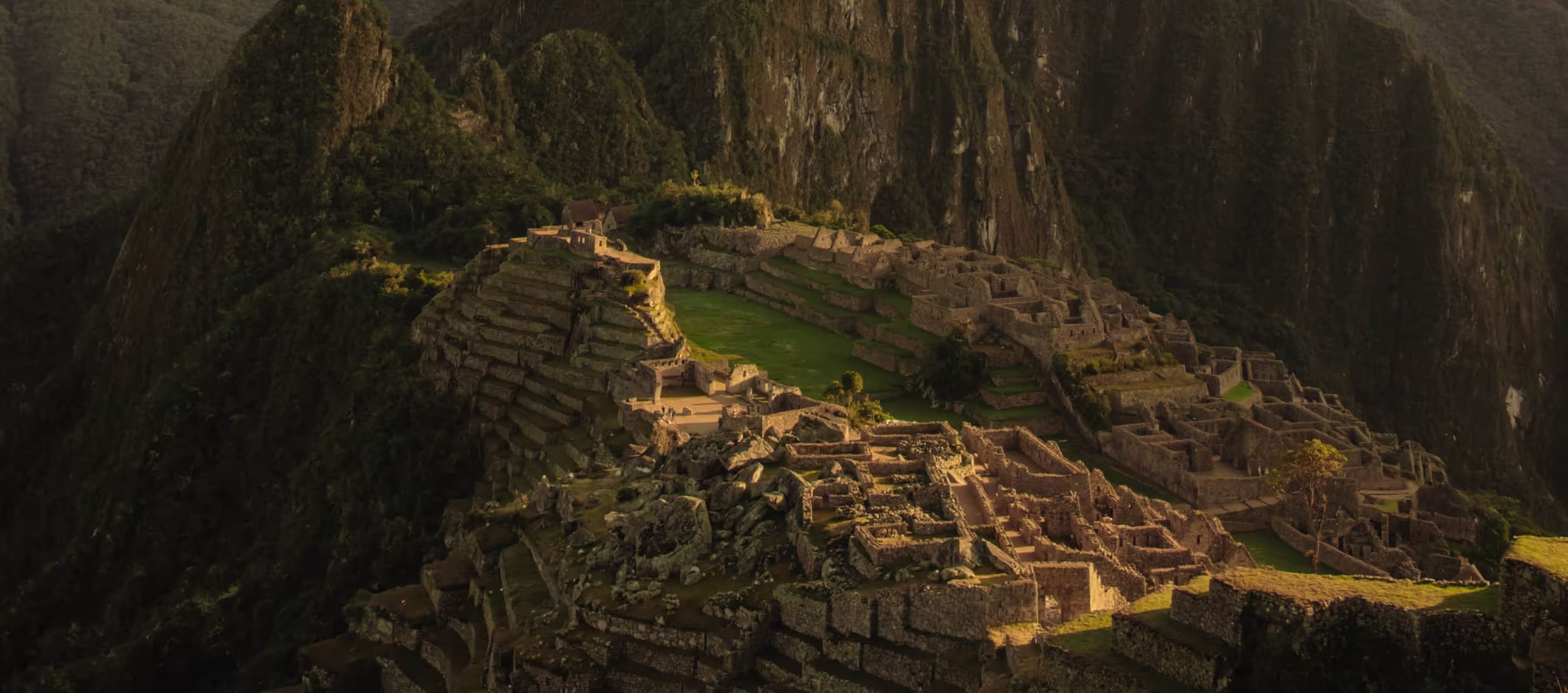
From inside the archaeological site's perimeter, at 5:40 AM, the view is the sanctuary in silence — no crowd, specific light, mist still settled in the valley below. From the canyon beneath Aguas Calientes, from a Cloud Forest View balcony at elevation above the Urubamba, the view is the gorge and the cloud forest descending from the massif — the ecosystem surrounding the site, not the site itself. From the Sacred Valley, sixty kilometres to the northwest, the view is the agricultural geography of the Inca empire: terraced hillsides still cultivated by Quechua communities, the Vilcanota river basin, the granary complex above Ollantaytambo. From above, in a helicopter following the Urubamba corridor from Cusco, the view is the geographic system as a whole — how the site occupies its bend in the river, visible only from altitude, unreachable from any hotel terrace.
These are four distinct visual experiences of the same mountain. They answer four different questions about it. A guest who wants to photograph the sanctuary in first light is not asking the same question as a guest who wants to understand the agricultural logic of the Inca system. Placing each guest in front of the correct angle — at the correct hour, with the correct preparation — is the curatorial decision.
This article organises those four angles and identifies which guest, and which kind of morning, each one corresponds to.
The View from Inside the Site — Belmond Sanctuary Lodge
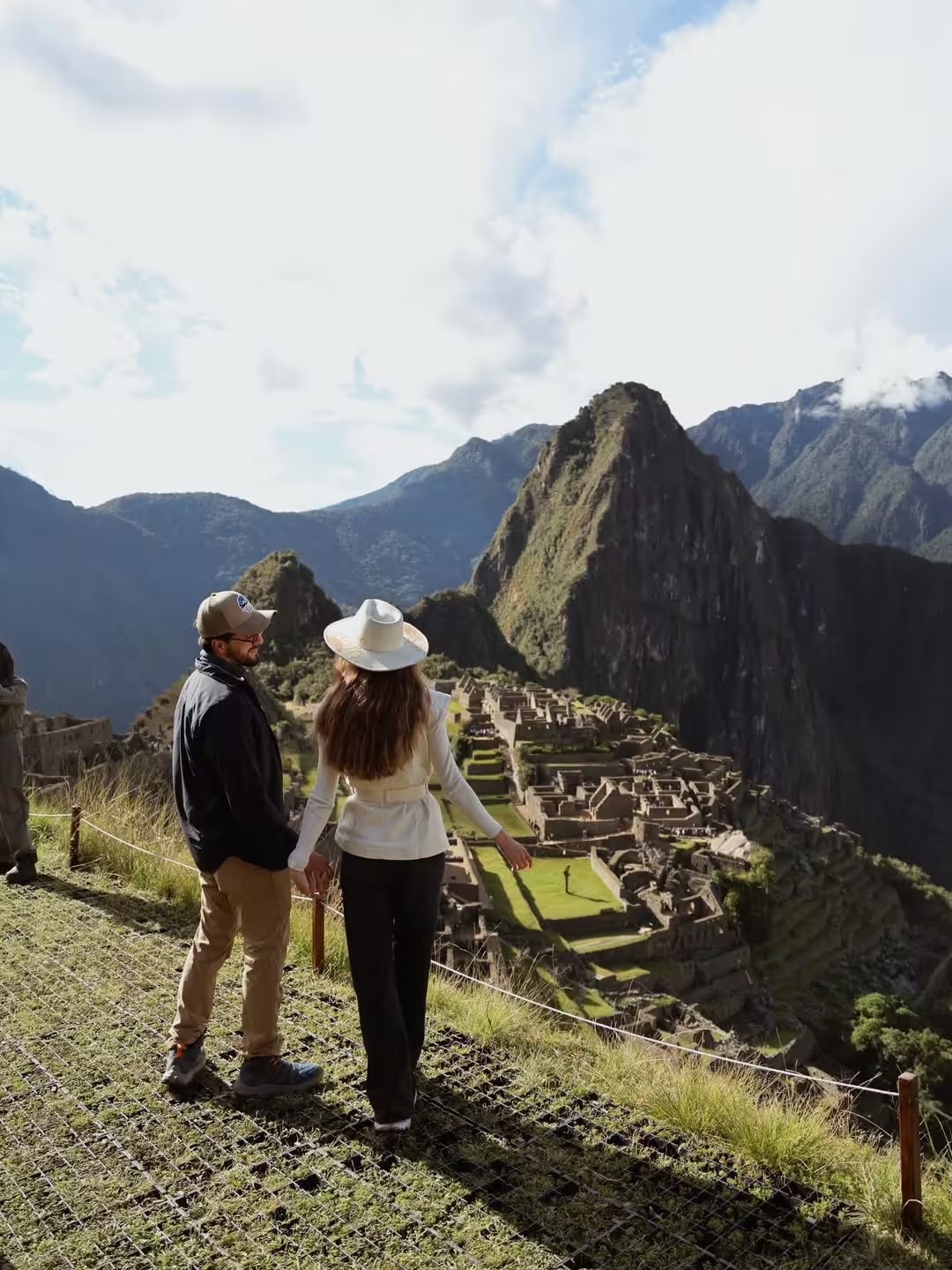
Thirty-one rooms immediately outside the entrance to the archaeological site. West-block rooms face the site's lateral perimeter wall; garden-block rooms face the vegetation behind the lodge. The partial, lateral view from west-block windows is not the panoramic Machu Picchu image that appears in travel photography — that image is taken from the Guardhouse terrace, accessible only from inside the site. What the west-block windows show is the outer wall of the sanctuary at close range, with the mountain ridge rising behind it.
The view the Sanctuary Lodge actually delivers is not a room view. It is a time view: the ability to enter the site at 5:40 AM, on foot, three minutes from the room, before the Consettur buses begin running from the village. The first hour at Machu Picchu — in near-silence, with perhaps twenty other guests, with the mist still in the valley — is structurally inaccessible to guests staying in Aguas Calientes, whose earliest bus arrives after lodge guests have already been inside for twenty minutes.
The same time advantage applies at the close of day. The last bus from the site departs at 5:00 PM. Sanctuary Lodge guests can remain until 5:30 PM, walking back independently as afternoon light falls across the west face of the mountain. No other guests in the area have access to that window.
The lodge's photographic programme — coordinated at USD 350 per person, including a professional guide and arranged access at specific non-peak hours — extends this time advantage into a structured experience. Kada adds to this arrangement a pre-visit briefing with a licensed archaeologist and a post-visit debrief, turning the photographic morning into an interpretive one.
The architecture of the lodge is modest relative to its rate. Rooms average forty square metres. The bathroom is functional, not remarkable. Guests who arrive expecting the design quality of a Cusco urban property are comparing the wrong thing. The Sanctuary Lodge charges for its location and for the time it makes available, not for its room quality.
Rate: USD 1,500–2,400 per night. The most expensive accommodation in the Aguas Calientes basin, priced for what it is — not what it looks like from the inside.
The guest this view corresponds to: A traveller for whom Machu Picchu is the centrepiece of the Peru journey — not one stop among several. Someone who has already understood what the site is, and now wants to experience it without the crowd that defines most visits. A photographer working in specific light conditions. A returning visitor who has seen the site in peak hours and wants the version available only to those who sleep at its gates.
The View from the Canyon I — The Cloud Forest (Inkaterra Machu Picchu Pueblo Hotel)
Eighty-three cabins distributed across twelve hectares of private cloud forest, fifteen minutes on foot from the centre of Aguas Calientes. The property does not touch the archaeological site. It borders the cloud forest that descends from the Machu Picchu massif — a different ecosystem, at a lower elevation, with its own population, its own hours, and its own reasons for being there.
From the Cloud Forest View balconies, the view is the Urubamba gorge: the river in the valley below, cloud forest above, the canyon walls rising on both sides. The sanctuary is not visible from these balconies. It is 25 minutes by bus up the mountain, behind the canyon wall. The view the balcony delivers is of the landscape that contains the site — the watershed, the cloud forest, the ecosystem that the Inca selected as the site's setting.
This distinction is what makes Inkaterra a different proposition from the other canyon properties. The ornithological observatory on the grounds has recorded 220 bird species, including fifteen threatened ones. The orchid sanctuary maintains 372 documented species — the largest private collection in Peru. The spectacled bear rehabilitation sanctuary operates on its own schedule, unrelated to anything happening at the archaeological site above.
Guests who stay at Inkaterra and spend every available hour at the site miss the property's actual proposition. Guests who spend two nights — one morning at Machu Picchu with a licensed guide, one morning in the cloud forest at dawn with an ornithologist, one afternoon in the orchid sanctuary with a botanist — extract a stay that has no equivalent elsewhere in the area.
Rate: USD 580–980 per night.
The guest this view corresponds to: A traveller for whom natural sciences and archaeological history carry equal weight. A couple or family for whom the Machu Picchu visit is one day within a larger Urubamba experience, not the entirety of it. An ornithologist or naturalist using the Aguas Calientes area as a field. A guest who values setting over logistical efficiency.
The View from the Canyon II — The River and the Kitchen (Sumaq Machu Picchu Hotel)
Sixty-two rooms in central Aguas Calientes, on the bank of the Vilcanota river. Three minutes on foot from the train station. Five minutes from the Consettur bus stop. Owned and operated by the Pérez Albela family, a Peruvian hotelier family without international chain affiliation.
From the Río View balconies, the Vilcanota moves continuously below — the sound and motion of the river audible throughout the night, the tropical vegetation on both banks, the canyon walls above. The site is 25 minutes by bus up the mountain. Sumaq does not position itself as a property from which one can see the sanctuary. It positions itself as the strongest base for a traveller who wants to engage with Peruvian hospitality and culinary craft at this end of the valley.
Wiñay, the hotel restaurant, serves the most serious kitchen in the canyon. The menu draws on Andean and Amazonian ingredients — quinoa from Puno, cocona and camu camu from the jungle, fresh trout from Titicaca — prepared with culinary intention that exceeds what the other properties offer. For the travelling gastronome, this is the operative variable.
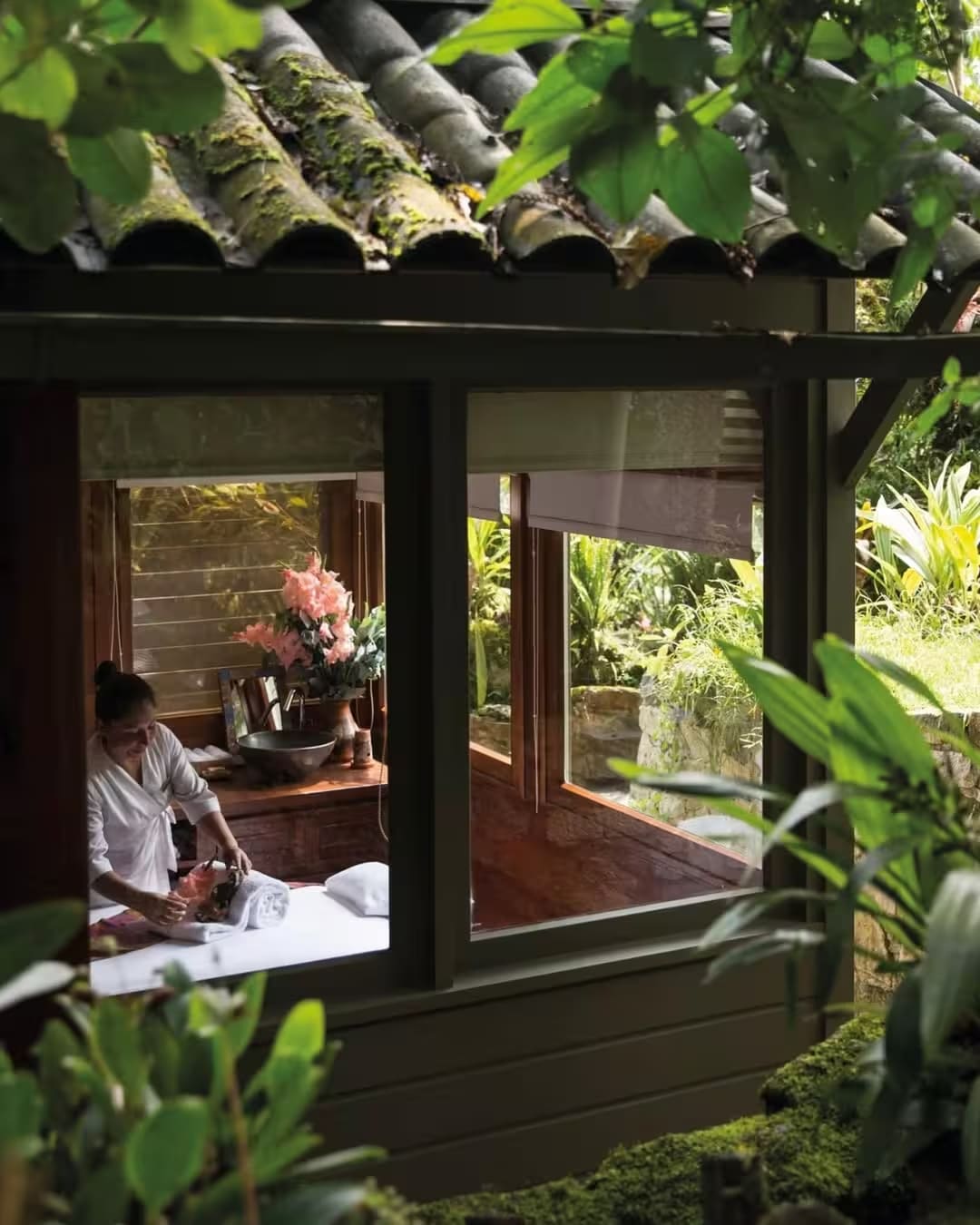
The spa treatments use coca leaf, muña, and Andean botanicals in protocols developed with local herbalists. The cultural programme — textile demonstration with artisans from surrounding communities, coca reading ceremony, Andean cooking class — is coordinated with producers in the valley rather than produced in-house. The result is a cultural encounter that draws on the communities, not on the hotel's interpretation of them.
Rate: USD 480–720 per night.
The guest this view corresponds to: A travelling gastronome for whom dinner quality is a meaningful part of the Andes experience. A guest who prefers Peruvian ownership and cultural authorship over international brand standards. A traveller with a precise onward connection who values being three minutes from the train station. A returning visitor seeking a different reading of the area.
The View Toward the Agricultural Valley — Sacred Valley Properties (60 km from the site)
The hotels of the Sacred Valley — Tambo del Inka, Sol y Luna, Belmond Río Sagrado, Inkaterra Hacienda Urubamba, Aranwa Sacred Valley — occupy the valley of the Vilcanota between Pisac and Ollantaytambo, at approximately 2,800 metres elevation. Machu Picchu is sixty kilometres to the south. The site is not visible from any hotel terrace in this valley, and this is not a deficiency. It is a different view of a different question.
From the terraces and balconies of these properties, the view is the agricultural geography of the Inca empire: terraced hillsides still cultivated by Quechua communities using techniques inherited from the imperial period, the Pinkuylluna granary complex rising above Ollantaytambo, the river corridor that served as the primary route from Cusco to the mountains. The sunset from the Belmond Río Sagrado's riverside terrace — the Vilcanota reflecting the last light, the terraces of Urubamba going into shadow, the granite peaks above — has no equivalent at the canyon properties.
Machu Picchu, understood in its original context, was the westernmost extension of the Cusco ceremonial complex — the furthest point of the empire's sacred geography from its capital. The Sacred Valley properties place the guest at the centre of that geography, not at its edge. Two nights in Ollantaytambo — the fortress at sunset, the active market at dawn, the agricultural terraces still irrigated by pre-Columbian canals — produce a reading of the site that no number of hours inside the perimeter can fully substitute.
Guests based in the Sacred Valley visit Machu Picchu as a full-day excursion: train from Ollantaytambo (1h 45min), bus from Aguas Calientes (25min), full site visit with guide, return by late afternoon. The view from their hotel terrace that evening is not of the site they visited — it is of the valley from which the Inca organised the construction of that site, and of everything that preceded it.
A Fifth Angle: The View from Above
There is a fifth angle that corresponds to no hotel and no canyon balcony. It is the view obtained in flight — specifically, in the helicopter corridor that follows the Urubamba river south from Cusco toward the massif.
The DGAC (Dirección General de Aeronáutica Civil) does not permit overflights of the archaeological site itself. The corridor approaches the massif from the northwest and descends along the canyon wall. What becomes visible at the closest legal approach point is the geographic logic of the site's placement: the way the mountain occupies the bend in the river, the asymmetry of the two summits — Machu Picchu and Huayna Picchu — the road from Aguas Calientes spiralling up the south face, the terracing on slopes that were never open to the general public. The scale of the setting, which cannot be felt from inside the site, becomes legible from altitude in a few minutes.
This view does not replace a ground visit. It reframes the visit that preceded or follows it. Kada coordinates the DGAC-compliant flight corridor, the atmospheric window (morning flights before cloud build-up in the canyon), and a brief with a geographer before the flight.
Rate: USD 1,500–2,500 per flight hour, charter, up to four passengers.
The Operational Question: Which View Belongs to Which Guest
Most itineraries to this region involve more than one type of morning. A traveller spending five nights in the Cusco–Sacred Valley–Aguas Calientes circuit is not choosing one of these four angles — they are sequencing two or three of them.
The photographer who wants the canyon dawn from an Inkaterra balcony and the site at first entry can have both: one night at Inkaterra for the cloud forest morning, one night at the Sanctuary Lodge for the pre-dawn site access. The gastronome who wants Wiñay's kitchen and the valley context of Ollantaytambo can have both: two nights in the Sacred Valley, one night at Sumaq in Aguas Calientes. The traveller for whom context matters as much as the site can open the itinerary in Ollantaytambo and close it at the Sanctuary Lodge — arriving at the site having already understood the valley it came from.
The aerial view fits most naturally into an itinerary where Machu Picchu is one element of a broader Andean survey rather than the sole destination: a flight over the corridor on arrival or departure from Cusco adds a scale of perspective that none of the ground-level views can provide.
The variable that most often determines which views are available is not budget — it is time. A traveller with forty-eight hours in the area makes different choices than one with five days. Identifying which combination of mornings, given the traveller's stated priorities and available days, corresponds to the version of this experience they are actually seeking — that is the curatorial decision.
What Kada Arranges
The accommodation decision — which property, which room category, which nights — is one layer of the itinerary. What happens at and around the site is a separate layer, arranged before departure.
For guests at the Sanctuary Lodge: dawn entry coordination with site staff; a licensed archaeologist or historian for the site visit (private, permit-cleared); optional photographic programme coordination with the lodge, to which Kada adds a pre-visit briefing and post-visit debrief with the archaeologist.
For guests at Inkaterra: coordination with the property's naturalist programme for cloud-forest mornings; ornithological guide for the dawn birding route; advance reservation at the orchid sanctuary. The Machu Picchu day visit is coordinated separately, with the same archaeologist access arranged for any other property.
For guests at Sumaq: preferred table arrangement at Wiñay; cultural programme scheduling with community artisans; site visit logistics and guide arranged independently of the hotel.
For guests based in the Sacred Valley: sunset positioning at the Pinkuylluna granary above Ollantaytambo; access to Pisac and Moray with a Quechua cultural interpreter; train reservation coordination from Ollantaytambo for the Machu Picchu day excursion.
For the aerial view: DGAC-compliant corridor booking through licensed Peruvian aviation operators; atmospheric window assessment; geographic brief before the flight.
Expert Perspective
The question I am asked most often about accommodation at Machu Picchu is which hotel has the best view. The honest answer is that none of them has what most people mean when they ask — the panoramic image that appears in every photograph is taken from inside the site itself, from the Guardhouse terrace, not from any hotel window.
What the properties have are four different relationships to the mountain and to the morning. I have placed clients in all four contexts — sometimes across consecutive nights in the same itinerary — and the one that produces the most lasting response is almost never the most expensive. It is almost always the one that corresponds most precisely to what the guest wanted their morning to feel like.
The guest who wants silence at the site before the first bus arrives belongs at the Sanctuary Lodge. The guest who wants the sound of the Urubamba from a balcony in the cloud forest belongs at Inkaterra. The guest who wants the strongest kitchen in the canyon and the most articulate Peruvian hospitality belongs at Sumaq. And the guest who wants to understand what Machu Picchu was — not only what it looks like — often belongs first in the Sacred Valley, where the context of the empire is still visible in the terraces.
Daniel Ramos, Co-Founder & CEO, KADA Travel
A Practical Note
Visibility and season: May through September offers the most consistent visibility at the site and from the canyon properties. April and October are shoulder months — lower rates, intermittent cloud cover that can produce atmospheric photographs or complete obscuration in the same morning. During the rainy season (November–March), morning visits are often clear, with cloud building through the afternoon. Some degree of morning mist should be expected in any season; it is part of the site's character, not an obstacle.
Altitude: Aguas Calientes sits at 2,040 metres — the lowest point in the standard Andean circuit. Sacred Valley properties sit at approximately 2,800 metres. Travellers who have acclimatised for two or more days in Cusco (3,400m) typically find both manageable. The site itself at 2,430 metres sits between the two.
Booking lead times:
- Sanctuary Lodge: eight to twelve months in high season (June–August); four months in shoulder.
- Inkaterra Machu Picchu Pueblo Hotel: four to six months in high season; two months in shoulder.
- Sumaq: two to four months year-round.
- Sacred Valley properties: two to six months depending on property and dates.
Aerial corridor: DGAC permits must be coordinated through licensed Peruvian aviation operators. Lead time: three to six weeks, subject to current regulations and seasonal restrictions.
Written by Daniel Ramos
Frequently Asked
There is no best view — there is a view that corresponds to each guest's specific morning and specific question about the site. The panoramic image of Machu Picchu that appears in most travel photography can only be obtained from inside the site, from the Guardhouse terrace. No hotel delivers it from a room window. The question to ask is not which hotel has the best view, but which morning corresponds to the experience you are actually seeking.
Yes, and it is frequently the format Kada recommends. One night at the Sanctuary Lodge for dawn site access and one or two nights at Inkaterra for the cloud-forest setting is a combination we have placed clients in successfully. Sacred Valley properties work well as an opening chapter — two nights in Ollantaytambo to absorb the valley context, then train to Aguas Calientes for the site visit. The aerial view fits most naturally as a prologue or epilogue to the ground-level sequence.
Cloud cover at Machu Picchu is common even in the dry season; morning mist is nearly universal year-round. A visit in mist or partial cloud is a different visit, not a failed one — the site's scale and layout remain fully visible, and the mist that settles in the valley below the Guardhouse terrace is one of the site's characteristic atmospheric conditions. Kada's pre-visit briefing prepares guests for this possibility and adjusts the photographic and interpretive approach accordingly.
The room view is lateral and partial — this is accurate and should be understood before booking. The premium is for the location and the time it makes available, not for room quality. For a traveller whose objective is a double visit — dawn entry before the first bus, late-afternoon exit after the last — no other accommodation in the area makes this possible. For a traveller who plans a single morning at the site and wants to maximise room quality relative to rate, Inkaterra or Sumaq deliver better value.
Design Your Journey
Design your bespoke Peru journey
We talk. We listen. Then we design an itinerary that belongs only to you.
Start Planning