Culture & Stories· 12 min read·7 February 2025
Contemporary Peruvian Art: Interrogation, Not Continuation of the Heritage
Peru is marketed as an archaeological destination — Machu Picchu, Cusco, Moche pyramids. But contemporary Peruvian art does not show who Peru was. It asks who it is. And the difference between those two positions changes how the country is read.
Peru is marketed with a clarity that flatters the itinerary and obscures the country. The proposal begins at Machu Picchu. The photographs show ruins at dawn. The description of Cusco emphasises the colonial churches. The internal logic of the standard archaeological itinerary is coherent and commercially effective — and it treats Peru as a country whose most important cultural production was completed before the sixteenth century.
Contemporary Peruvian artists disagree. Not in statements. In the work.
There is a meaningful distinction between an art scene that supplements a country's cultural identity and one that interrogates it. The first is additive: the country already knows who it is, and the art decorates that knowledge with new formats and materials. The second is something more demanding: the artists are using the work to ask questions the country has not finished answering. Peru has the second kind of scene.
Fernando Bryce does not decorate the internal war — he forces it into visibility by painstakingly redrawing state documents from the years of political violence. Claudia Llosa does not supplement the colonial heritage — she traces what that heritage did to the bodies of women four centuries after the conquest. Susana Baca does not represent Afro-Peruvian culture for an audience curious about folk traditions — she argued, over decades of work, for its standing in a country that had decided not to hear it.
The framing "Peru also has contemporary art" is the defensive version of an argument that deserves to be stated directly: contemporary Peruvian art is where the country is currently examining itself. The archaeological sites record what Peru built. The contemporary scene records what Peru is asking.
The difference between those two positions changes what a traveller is doing when they visit.
Movement I — The Open Archive: Five Simultaneous Pasts
The premise that makes contemporary Peruvian art intelligible is the same one that makes the purely archaeological itinerary insufficient: there is no single Peruvian past. There are five, and they remain simultaneously active.
The first is pre-Inca — not one culture but a constellation of them. The Moche of the northern coast produced portrait ceramics of psychological specificity that still resist easy classification — vessels modelled on individual faces, images of ceremony and warfare, metalwork of technical sophistication that the Spanish invaders documented with something close to disbelief. The Nazca of the southern desert created geoglyphs whose scale presupposes an aerial perspective the civilisation did not have, or not one we can explain. The Chavín of the central highlands established iconographic grammars that persisted across cultures for centuries. These civilisations did not simply precede the Inca; they produced technical and aesthetic traditions that the empire absorbed, adapted, and partially suppressed in the process of consolidation.
The second is Inca — the imperial civilisation whose monumentality is what tourism recognises. Machu Picchu, Sacsayhuamán, the terraced agriculture of the Sacred Valley: a built environment of such precision that it continues to resist comprehensive explanation. The Inca empire at its height lasted less than a century before the Spanish arrived. The brevity makes its architectural legacy more consequential, not less.
The third is colonial — three hundred years of Spanish rule that produced the Cusco the traveller sees today: a city where Inca stone walls became the foundations of Baroque churches, where Quechua cosmology survived inside Catholic iconography as the painters of the Escuela Cusqueña embedded Andean figures, animals, and symbols into canonical scenes of Christian iconography. The Last Supper served with guinea pig and chicha. The Virgin dressed in a shape that echoes a mountain. The colonial past is not historical distance — it is the civic and architectural fabric of nearly every Peruvian city.
The fourth is republican — two centuries of independent Peru that have been trying to construct a national identity from material that does not obviously cohere. The War of the Pacific (1879-1884), in which Peru lost significant southern territory to Chile, produced a wound the country's cultural history has never fully closed. The question of what "Peruvian" means — racially, linguistically, geographically — remains officially unresolved and politically active.
The fifth is contemporary: the internal war of 1980-2000, in which approximately seventy thousand people died; the explosive urbanisation of Lima, which grew from under a million inhabitants in 1950 to over twelve million today, largely through migration from the sierra and jungle; the Peruvian diaspora distributed across Spain, the United States, Japan, and Chile; and the globalisation that simultaneously gave Peruvian cuisine international standing while raising the question of what cultural authenticity means when it is priced in dollars and curated for international taste.
Contemporary Peruvian artists work with all five simultaneously. The failure of the archaeological-only itinerary is not that it ignores the contemporary — it is that it treats one of these five archives as definitive when all five remain open.
Movement II — The Interrogation: How Art Asks
The Question of Indigeneity
Martín Chambi (1891-1973) is the foundational figure of this argument. His photographic archive — produced between the 1920s and 1940s from his studio in Cusco — did something formally radical for its context: it treated Andean subjects as photographic subjects of consequence. The portraits of Quechua men and women in highland towns, the documentation of fiestas and agricultural ceremonies, the images that placed Andean life in the frame with the compositional seriousness previously reserved for European subjects — Chambi was not documenting indigenous culture for an outside audience. He was arguing, through the formal decisions of photography itself, for its dignity. His archive is national heritage not because it records a vanishing way of life but because it refused that frame from the beginning.
Christian Bendayán continues a different strand of the same argument. His paintings insist on the Amazon not as ecological backdrop but as inhabited territory — and on its peoples not as subjects of anthropological documentation but as the holders of a visual language with its own formal logic. In a country where "Peruvian" has long defaulted to meaning "Andean," Bendayán's work argues for the Amazon as equally constitutive of the national archive.
Susana Baca represents the equivalent argument in music. The Afro-Peruvian coastal tradition — developed in the agricultural communities of Chincha and El Carmen by the descendants of enslaved Africans brought to colonial Peru — was the largest invisible archive in the country's cultural history. It was not recovered by Baca; it was claimed. Her Grammy-winning work is not nostalgia for a lost tradition; it is a formal argument that the tradition was never lost — only denied the standing it deserved.
The Question of Trauma
Fernando Bryce's practice involves the appropriation and painstaking redrawing of historical documents: press cuttings, state communiqués, newspaper front pages from the years of political violence. The gesture is deliberate, obsessive, and formally demanding — and it forces the viewer to look at material that the country has collectively decided to archive rather than examine. The internal war years are within living memory. Bryce's work insists on that proximity. The paintings about Sendero are not history paintings; they are news from a past that has not finished arriving.
Claudia Llosa's La Teta Asustada (The Milk of Sorrow, 2009 Berlin Golden Bear) operates from a premise that sounds like Andean mythology but functions as psychological analysis: that the trauma of the internal war years can be transmitted from mother to child through the most intimate biological channel. The film's protagonist embodies the consequences of violence she did not personally experience but carries in her body. Llosa is not representing a historical period. She is arguing that its effects remain physically present in the generation born after the violence ended.
Vera Lentz's documentary photography of the communities affected by the conflict places specific faces and bodies before audiences that would prefer the period to remain statistical. The work is not memorial — it is evidence with faces.
The Question of Plural Identity
Julia Wong's poetry engages the Peruvian-Chinese identity — the Tusán community, descended from labourers brought to Peru in the nineteenth century — not as hyphenated compromise between two cultural claims but as a distinct epistemic position that neither Lima nor Beijing entirely contains. The question of what "Peruvian" includes is answered differently from her position, and the answer has implications for every other Peruvian whose inclusion the mainstream narrative has treated as negotiable.
Daniel Alarcón, Peruvian-American, writes in English about Peru from the diaspora. Lost City Radio is set in an unnamed Latin American country recovering from internal conflict; it is unmistakably Peru. Writing in English, from outside the country, about events the country prefers to consider closed — this is not the diaspora looking in with longing. It is a position from which certain things are visible that are not visible from inside. Ricardo Sumalavia's short fiction operates in a different register — the Kafkaesque absurdity of modern Lima — but with the same interrogative insistence on what the city is actually like for those navigating it.
Novalima refuses the category of "world music" not in interviews but structurally: the electronic production is not a framing device for Afro-Peruvian traditional forms. It is in direct dialogue with them. What twenty-first-century Lima sounds like when it stops performing modernity and starts examining itself — that is what Novalima sounds like.
The Question of Material
Sandra Iturriaga and Patricia Llosa, in their respective landscape and architectural practices, have worked in Peru by asking which materials have genuine standing in the places they build and why. Adobe, stone, quincha — and Carlos Williams's engagement with pre-Columbian structural logics in contemporary Lima residential architecture — are not vernacular references designed to signal cultural sensitivity. They are materials with technical development histories extending across millennia. To design with them is to acknowledge an archive; to ignore them in favour of imported alternatives is a choice that carries its own argument.
MozhDeh Matin and Sumy Kujon, working in textile design and fashion, engage Andean fibre traditions — the spinning, dyeing, and weaving techniques of highland communities, the specific properties of alpaca and vicuña — with a formal rigour that refuses the category of artisanal craft. Alpaca Studio's furniture work makes the same argument in a different medium: Scandinavian structural logic and Andean material tradition are not in opposition. They can be placed in direct conversation, and the conversation produces something that neither tradition produces alone.
Pia León's ingredient work operates on equivalent territory in gastronomy: the question of which Peruvian territories — coastal, highland, Amazonian — are granted standing on a single plate is a question about what Peru is, not only about what it produces. The provenance list at a serious Lima table is not marketing. It is a position.
Movement III — Where It Converges: Barranco and Beyond
Lima's Barranco district functions as the institutional and informal centre of contemporary Peruvian cultural production. This is not accidental — the neighbourhood's position, at a distance from the commercial centres of San Isidro and Miraflores, has allowed it to develop the density of galleries, studios, and cultural spaces that a serious creative ecosystem requires.
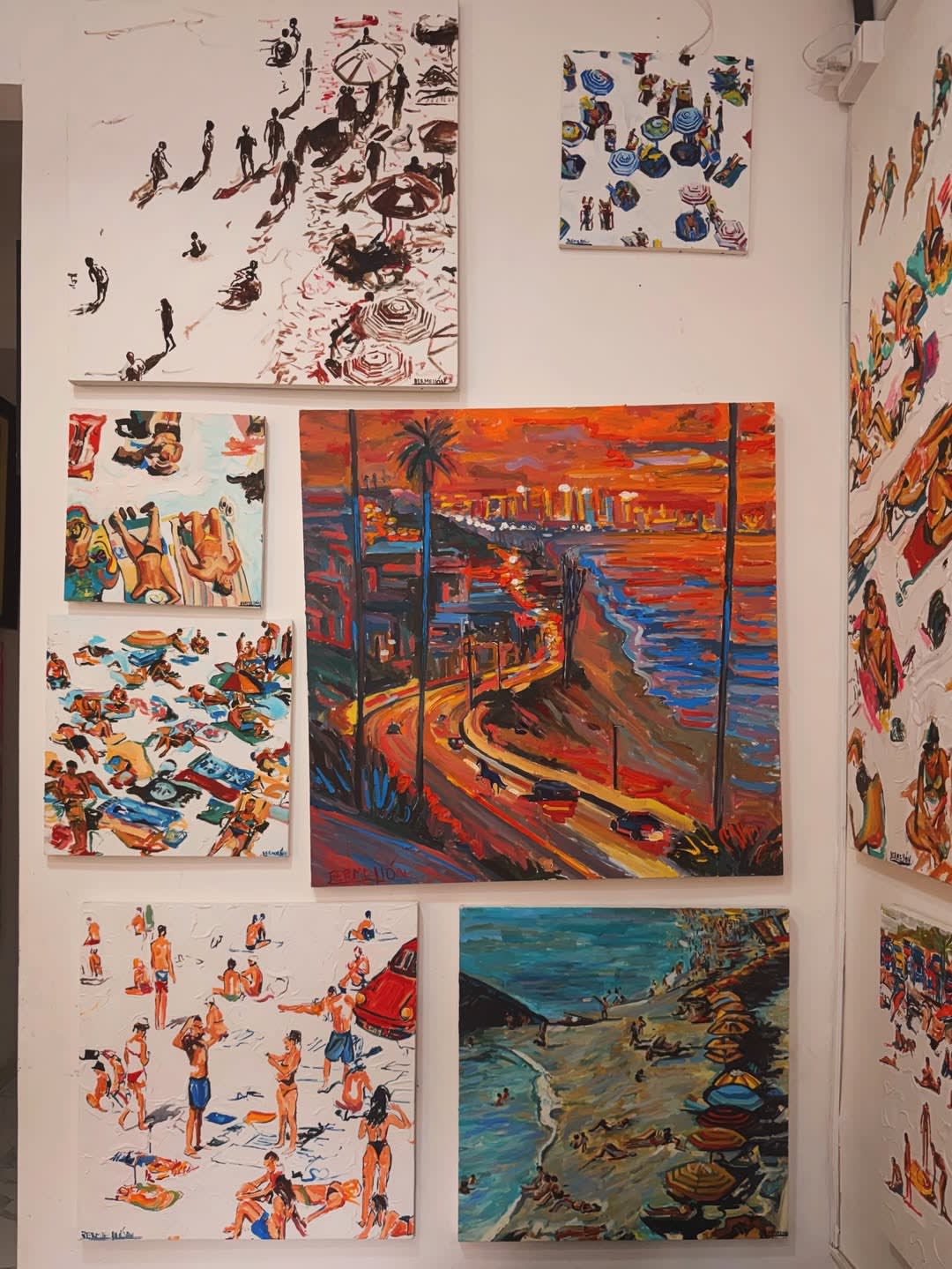
The Museo de Arte Contemporáneo (MAC Lima) provides the institutional anchor for visual art: a permanent collection that holds work from Fernando Bryce, Joaquín Iglesias Ramírez, Renzo Vega, Alfredo Márquez, Sandra Gamarra, Luis Daniel Galindo, Sergio Zevallos, Lola Bermúdez, and their contemporaries — paintings, installations, and conceptual works that constitute the primary institutional record of what contemporary Peruvian visual art has been producing for four decades — alongside a programme of rotating exhibitions that engages the current field. The MALI — Museo de Arte de Lima — holds the longer historical arc, from pre-Columbian periods through to the present, placing the contemporary work in the context of what it is responding to.
MATE, the foundation established by photographer Mario Testino, has consistently brought serious attention to contemporary Peruvian photography alongside major international figures. The documentary and landscape traditions represented by Giovanni Burda and Domingo Giribaldi — photographers who have spent careers recording the diversity of Peruvian life and territory — are part of what the institution holds. The independent gallery layer — Galería Lucía de la Puente, Galería Wuxiu, and the smaller spaces whose programmes are less predictable and more immediate — is where the more recent arguments surface before reaching institutional circulation. These galleries are not secondary to the MAC; they are where the questions are first articulated.
The Casa de la Literatura Peruana, in Lima's historic centre, holds the literary production: an archive that runs from Vargas Llosa and Alfredo Bryce Echenique through Daniel Alarcón and Ricardo Sumalavia to the writers currently working, alongside a programme of readings and exhibitions that takes seriously the question of what a national literature is and who has standing within it.
For music, the Centro Cultural PUCP and Teatro Segura have hosted the formal tradition — Eva Ayllón's Peruvian criolla repertoire, as architecturally rigorous as any concert hall programme — alongside the more recent work of Damaris, whose production places Andean referents within contemporary rock structures with a compositional directness that neither genre typically achieves alone.
The Lima Independiente festival (October annually) is where cinema and video art become visible as a field: Joel Calero's documentary work on Peru's economic and social margins, Daniel Vega's fiction films about the Lima middle class navigating its own contradictions, and the video and installation work that rarely circulates beyond the festival context. The Bienal de Lima, biennial, is the moment when the city's visual art production becomes legible as an argument about where the field currently stands.
Beyond Lima: Cusco's contemporary art scene is small, serious, and distinct from both its colonial heritage and its archaeological tourism infrastructure. The Amazonian art emerging from Iquitos engages the visual traditions of the basin's communities with a formal rigour that the "naïve art" category consistently undersells.
Movement IV — Why It Matters for the Traveller
The Italian comparison is instructive. A traveller to Italy who sees the Colosseum and Pompeii without engaging the country's living culture — without Arte Povera, without the Italian architectural conversation with its own built history since the twentieth century, without the cinema that gave the country a different kind of self-knowledge than the monuments ever could — returns with an account of Italy that ends in the second century. They have visited monuments. They have not encountered a living culture.
The equivalent reduction in Peru is more common because the monuments are more extreme and because the travel industry has successfully structured its offer around the pre-Columbian archive. But the reduction is no less consequential.
A traveller who has spent time with the contemporary art scene before arriving at the archaeological sites carries different questions to those sites. Qoricancha — the Inca Temple of the Sun, incorporated into the Dominican church of Santo Domingo — is a more complex site after time at the MAC: the mechanism of cultural survival through encoding, of one system of meaning surviving inside the formal structures of another, is visible in both contexts. A day in Barranco provides the vocabulary to read it at the site rather than only to see it.
Machu Picchu is a more contested site after Fernando Bryce — not because Bryce addresses the Inca directly, but because his practice of forcing visibility onto what the country prefers to archive raises a specific question about the spectacularisation of the archaeological past: what is this place being used to say about Peru now, and for whom is that argument being made?
The Nazca Lines, encountered in the context of a broader understanding of pre-Columbian visual cultures that contemporary artists are actively in dialogue with — argumentatively, not reverently — become less of a mystery and more of an invitation to a conversation that has not closed.
This is not about cultural preparation making the archaeology more enjoyable. It is about the difference between visiting a place as a spectacle and reading it as part of an ongoing argument. The contemporary scene is not the supplement to that argument. It is where the argument currently lives.
One day with the contemporary production. At the beginning of the itinerary.
What Kada Coordinates
The contemporary cultural programme works best as the first day of a Peru itinerary — Lima on arrival, before the flight to Cusco or the Colca or the Amazon. What changes is not the experience of the contemporary art itself; it is the experience of everything that follows.
Kada's curation of the Lima contemporary day includes private access to working artist studios in Barranco — encounters with work in progress rather than work resolved — and the gallery circuit with an art historian who knows what is currently showing, why it matters, and how it connects to the broader argument the city is making. Both experiences are documented in the Unfolded series below.
For travellers with specific interest in the music archive, access to the Instituto Negrocontinuo — Susana Baca's thirty-year project of recovering and archiving Afro-Peruvian musical tradition from the communities of Chincha and El Carmen — is coordinated separately and operates on its own terms. It is not a museum visit. It is a conversation with an active archive.
Access to private collections is coordinated case by case, depending on the current programming and availability. The Lima Independiente festival in October and the Bienal de Lima are worth factoring into itinerary timing for travellers whose interest extends to the cinema and large-scale visual art fields.
The contemporary programme is not an addition to a Peru itinerary. It is the lens through which what follows becomes legible.
Editorial Perspective — Katherine Cjuiro, Founder
I have been bringing travellers to Peru for fifteen years. The difference between a traveller who has spent a morning in the MAC before arriving at Machu Picchu and one who has not is not a difference of cultural preparation or art-world familiarity. It is a difference in the quality of the questions they ask at the site.
The traveller who came through Barranco looks at Machu Picchu and asks: what is this place being used to say about Peru now? They have spent time with artists who are asking exactly that question about their own country — about what the country preserves and what it prefers not to see — and the habit transfers.
The archaeological Peru is extraordinary. The question has never been whether to visit it. The question is whether you visit it as a spectacle or as part of an ongoing argument the country is still having with itself. The contemporary scene is not the supplement to that argument. It is where the argument currently lives.
The Peruvian artists I most respect are not illustrating their country. They are interrogating it. That is what the country deserves from those who come to see it.
— Katherine Cjuiro, Founder, KADA Travel
A Practical Note
Contemporary galleries and cultural institutions in Lima are open year-round and do not follow an archaeological season. Their programming cycles run independently of the weather conditions that govern trekking conditions in the Andes.
Most private galleries in Barranco and Miraflores observe Tuesday-to-Saturday hours; Monday closures are standard practice. The MAC and MALI maintain broader opening schedules with reduced hours on specific days — verify current hours before visiting.
The Lima Independiente festival takes place annually in October and is the largest concentrated presentation of contemporary Peruvian film and video art of the year. The Bienal de Lima runs on a biennial schedule; the next edition should be confirmed through current Lima cultural programming.
One full day is the minimum for a serious engagement with the Lima contemporary circuit. Two days — one oriented toward the major institutions, one toward the independent galleries and studios — covers the field without becoming exhaustive. For travellers arriving in Lima on the first day of a Peru itinerary, the contemporary day is the most productive use of the hours before the domestic flight to Cusco.
Frequently Asked Questions
Do I need prior knowledge of contemporary art to benefit from a day in Barranco? No. The art historian Kada coordinates for the gallery circuit is specifically selected for the capacity to make unfamiliar work accessible without simplifying it. The relevant outcome is not art-world fluency — it is the specific perceptions that change how the rest of the Peru itinerary reads. Travellers with no prior exposure to contemporary art consistently report that the MAC day changes their experience of the archaeological sites more than any other single element of the preparation.
How does a contemporary art day fit into an archaeological itinerary? At the beginning — Lima on arrival, before flying to Cusco. The contemporary work functions as context for what follows, not as an optional appendage to a completed trip. The archaeological sites read differently after Barranco; the reverse is not true in the same way. A traveller who does the MAC on their last Lima day is processing context after the fact; one who does it on arrival is carrying it forward.
Is it worth attending the Bienal de Lima if timing coincides? Yes, if the itinerary allows. The Bienal is not primarily a tourist event — it is the occasion when Lima's visual art world assembles to assess where the argument currently stands. Attendance during the Bienal requires advance coordination; Kada handles this for travellers whose dates align and who have given sufficient lead time.
Can I meet a working Peruvian artist? With advance coordination and the right timing, yes. The studio visit Kada coordinates in Barranco is an encounter with an artist in the process of work — not a tour of a resolved and curated space. This depends on artist availability and current programme; it cannot be guaranteed on demand. When it works, it is the most consequential two hours of a Lima day.
Does Cusco have a contemporary art scene worth visiting? Yes — small, serious, and distinct from both the colonial heritage and the archaeological tourism infrastructure. For travellers spending several days in Cusco, Kada can coordinate access to what is currently showing and, where possible, to the studios of artists currently working in the city.
Written by Katherine Cjuiro
Design Your Journey
Design your bespoke Peru journey
We talk. We listen. Then we design an itinerary that belongs only to you.
Start Planning